
The cutting board you use matters more than you think. Using the same surface for raw meat and produce is one of the top causes of foodborne illness at home — and the fix costs less than $15.
I can’t say I’ve had a good experience with cutting boards. I remember the bamboo one that warped in 6 months. Or the cheap plastic one that slid off the counter every single time I tried to chop something. Or the gorgeous wooden one that I still wash by hand like it’s a family heirloom. I guess it might just become one.
After years in the kitchen doing everything from Sunday meal prep that takes up the entire kitchen to weeknight casserole construction, I have experience and developed strong opinions on what actually works. The nine cutting boards I have listed on Amazon have thousands of reviews and are perfect for daily use, meat boards, cheese boards, and for making your protein color coding dreams come true!
What Actually Matters in a Cutting Board
A short explanation about the materials before the list, as the materials affect the performance of the board in all other areas.
Plastic vs. Wood: The Real Answer
The FDA recommends plastic cutting boards for cutting raw meat and poultry because they are non-porous and can be washed in the dishwasher. While plastic boards can go in the dishwasher, wood boards cannot because they need oiling that hinders cracking. The high grain density of wooden cutting boards makes them naturally antibacterial. A well maintained wooden board compared to a poorly maintained plastic one will be an antibacterial board compared to the plastic one. A poorly maintained wooden board will be more antibacterial than a deeply scored and poorly maintained plastic board.
The smartest kitchens use both plastic for raw protein and wood for veggies, bread, and cheese.
Bamboo vs. Acacia Wood
Bamboo is grass, not wood. Because bamboo cutting boards are tougher than most wooden boards, they show less knife scarring. The downside is that bamboo boards are harder on your knife blades. Acacia wood is in the middle: denser than pine or maple, but softer than bamboo. This means that acacia wood cutting boards are easier on knife edges while still standing up to everyday use.
The Features Worth Paying For
- Juice grooves — Juice grooves prevent liquid from running off the board onto the counter. They matter most when cutting meat, citrus, or tomatoes.
- Non-slip feet or edges — A cutting board that slides is a safety issue. Look for rubber feet, a non-slip border, or a damp towel underneath.
- Reversible design — Both sides usable means twice the surface life before a board needs replacing.
- Dishwasher safe — Only applies to plastic boards. Wood and bamboo should always be hand-washed.
No. 01
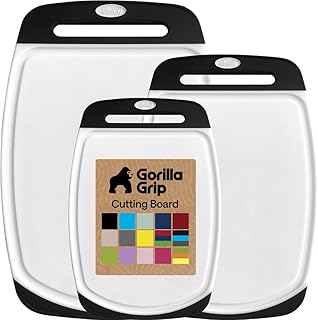
The non-slip border is what separates this from every other plastic board — it grips the counter without a mat underneath, which matters when you’re pressing down hard on a butternut squash or breaking down a whole chicken. BPA-free and dishwasher safe, the set of three gives you one for raw meat, one for produce, and a spare. The black colorway doesn’t show knife marks the way white boards do, which is a genuinely useful thing nobody mentions. At 51,900+ reviews with a 4.6 rating, this is one of the most-validated kitchen purchases on Amazon.
No. 02

At 15×20 inches, this is genuinely large — enough to cut, sort, and stage an entire recipe’s worth of ingredients without running out of room. The juice groove runs around the full perimeter, not just one end, which catches runoff from every direction. Dishwasher safe plastic, non-slip surface, and Farberware’s name behind it. This is the board I’d put in front of anyone who does serious meal prep on Sundays — it handles volume without complaint. It holds a 4.6-star rating across 19,000+ reviews and carries the Amazon’s Choice badge.
No. 03

Sometimes the right answer is just a sturdy, no-frills plastic board that you don’t have to think about. This one has a handle for easy maneuvering, dishwasher-safe plastic, and 19,000 reviews backing it up. It gets bought 6,000 times a month — that’s not a fluke. The handle is genuinely useful for sliding cut food directly into a pan without the transfer step. If you want one board that does the job and costs less than a latte, this is it.
No. 04

Bamboo is harder than most wood, which makes it more resistant to knife scarring and easier to keep looking clean. The tradeoff is that bamboo is also harder on knife edges over time — so this is a better choice for vegetables, bread, and cheese than for daily meat prep. The deep juice grooves here are well-designed and actually catch liquid rather than pooling at a shallow angle. At 53,800+ reviews this is one of the most-reviewed cutting board sets on Amazon. Hand wash only and occasional oiling keeps it going for years.
No. 05

Most cutting board manufacturers condition their wood with food-grade mineral oil, which is petroleum-derived and food-safe — but plenty of people prefer to avoid it. Ziruma uses beeswax, flaxseed oil, and lemon oil instead. The FSC certification means the acacia is sustainably sourced. At 16×11 inches and nearly an inch thick, this is a serious board — heavy enough to stay put without rubber feet. Bought 1,000 times last month despite costing nearly $40, which says something about the people who prioritize what’s on their board over what the board is made with.
No. 06

Edge-grain acacia construction means the wood runs parallel to the cutting surface — this is the standard for most wood boards and is a good balance of knife-friendliness and durability. End-grain boards (wood running perpendicular, like a traditional butcher block) are gentler on knives but harder to find and more expensive. Sonder’s set comes in 14×10 and 12×8 sizes, arrives in a gift box, and has the kind of rich grain pattern that makes it genuinely pretty to look at on a counter. This doubles as a charcuterie board — put it out at a party and people ask where you got it.
No. 07
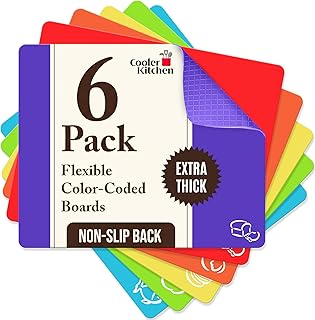
Cross-contamination between raw meat and produce is one of the leading causes of foodborne illness at home. Color-coded cutting boards are the most practical solution — each color corresponds to a food type (red for meat, green for produce, yellow for poultry, etc.) and the food icons printed on each mat eliminate any guessing. Flexible mats fold into a funnel shape for transferring cut ingredients directly to a pan. BPA-free, dishwasher safe, 16,200 reviews. At under $12 for six boards, this is the most cost-effective food safety upgrade in the kitchen.
No. 08

This set steps up from a basic plastic board by adding actual grip handles, deeper juice grooves, and a size range that covers everything from quick fruit prep to a full roast. The dark grey color reads as intentional rather than clinical — these don’t look like cafeteria equipment. Dishwasher safe, BPA-free, and at 4,700 reviews the quality is consistent. The handles are genuinely useful for people who like to slide cut food into a skillet without a second utensil.
No. 09

The holder is the differentiator here — three boards displayed upright on a stand look organized and intentional, not just stacked in a drawer. Acacia wood with juice grooves on each board, three sizes for different tasks. At 15,000 reviews and 4.5 stars this is a genuinely well-rated set, not a viral gimmick. The grain patterns vary board to board, which is characteristic of solid acacia and actually adds to the aesthetic. Oil occasionally with food-grade mineral oil or beeswax and these will last years.
How to Choose the Right Cutting Board for Your Kitchen
What size cutting board do you actually need?
The most useful size for daily cooking is 12 x 10 inches. If smaller boards are used, then it becomes frustrating to keep everything contained on the board, as ingredients are pushed off the sides repeatedly. For meal prep or cooking larger pieces of meat, the ideal size is within the range of 15 x 12 up to 15 x 20 inches. A good rule of thumb is that your cutting board should be at least as wide as your longest kitchen knife.
Is wood or plastic better for cutting boards?
The FDA recommends plastic boards since they are non-absorbent, and dishwasher safe. The FDA also suggests using plastic for raw meat, poultry, and seafood. For veggies, cheese, and bread, boards made of wood are preferable as they are more blade-friendly, and wood (especially acacia and maple) has natural antibacterial properties. Best case scenario, you have one plastic board for proteins, and one wooden board for everything else.
Are bamboo cutting boards good for knives?
Because bamboo is so strong, the cutting boards made from it are durable and resistant to scoring. Bamboo is hard on the edges of your knives, though. Bamboo cutting boards, when compared to others, are probably better for cutting vegetables, fruits, and bread, rather than for daily prep work involving meats and very sharp knives.
How do you clean and care for a wood cutting board?
Wooden cutting boards need to be washed by hand. Use hot water with soap, and dry the board immediately. Do not soak them, and do not wash them in the dishwasher, as the wood may crack and warp due to the water. For sanitizing, rub down the cutting board with lemon halves and some coarsely ground salt, and rinse. The boards need to be oiled once a month or when the wood appears dry. For this, you can use food safe mineral oil. It is better if you do not use olive oil or vegetable oil, as they can become rancid.
How do you prevent cross-contamination with cutting boards?
The best practice is to use color codes. Different color mats can be selected for different types of boards. For instance, red can be used for raw meat, yellow for raw poultry, green for vegetables, and blue or white for cooked food. These mats can help you cut down on some of the cognitive load, as they have pictures of food on each mat. After each use, boards should be washed using soap and hot water. Any score-marked boards that can’t be cleaned should be disposed of.
How long do cutting boards last?
Plastic cutting boards need to be replaced when the first deep knife marks go all the way down to the surface. These cuts trap bacteria and can’t be cleaned away, even with soap and hot water. Wood and acacia boards, with the right care, can last up to 10 years or more. Flexible cutting board mats last 1–3 years with typical use.
The Bottom Line
Having a great cutting board can make almost any recipe easier to follow, and picking the right one ultimately depends on what food you’re cutting. Still, it isn’t the end of the world if you just have one. The Gorilla Grip Board Set is a good starter option for every cook. You receive three boards with a slip-resistant border along with 51,900 other satisfied customers who have left positive feedback, so you know it works. For a wood alternative, the Sonder Los Angeles Acacia Board Set is a nice option that is regularly highly rated. Lastly, if you need to handle a food safety issue (and to be honest, we all do), the most practical choice you can make from this list are the color-coded flexible cutting mats.
All nine boards can be found on Amazon with Prime delivery. Prices change — see each link above for current prices.